Tool watches encompass a wide swath of styles. A tool watch is a somewhat loose term describing a durable, purpose-built wristwatch designed for practical use rather than decoration alone. It’s all about quick legibility, robust construction, and features that serve a specific task. Dive, field, pilot, racing, and GMT watches are common examples.
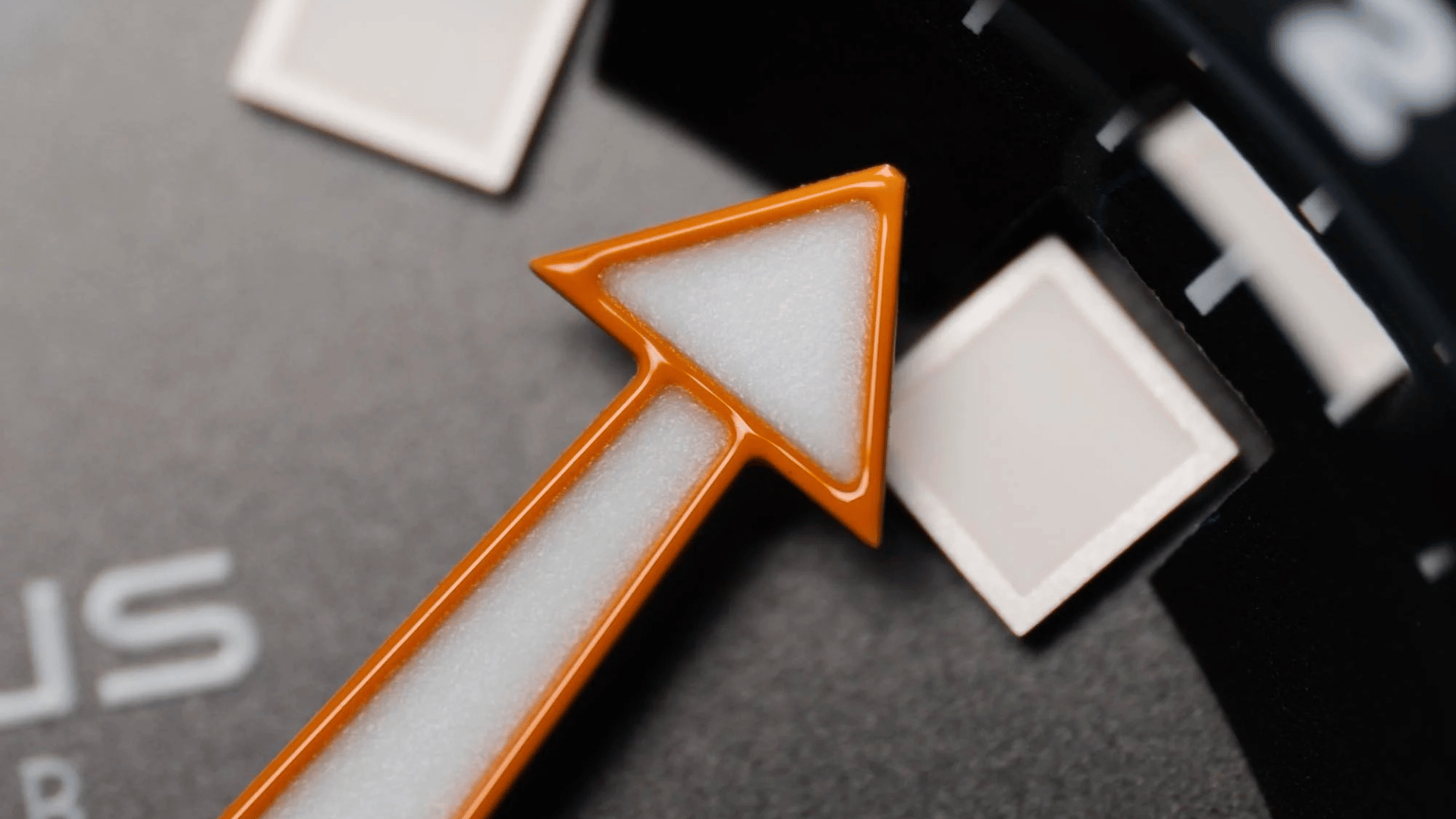
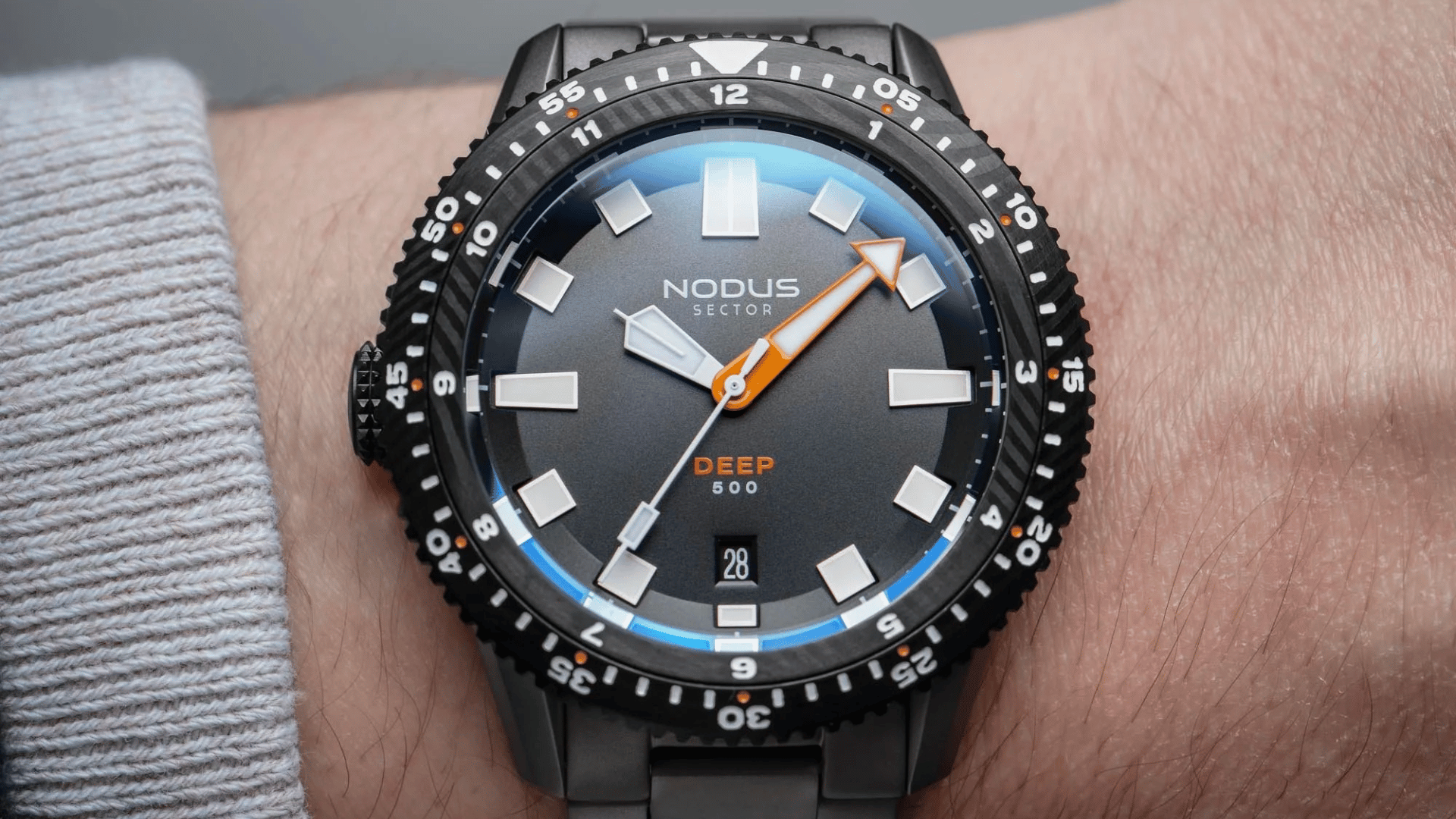
The Nodus Sector Deep 500 fits the category as a dive-oriented tool watch, with a grippy timing bezel, bold luminous markers, a prominent orange minute hand, and 500-meter water resistance.
Nodus’s Sector Deep line is, well, deep. Originally, just one black dialed model debuted, and it sold out quickly. Then, other members arrived with a rainbow of colors, a fully DLC (Diamond Like Carbon) version, and a GMT line. The Sector Deep Damascus is one of the brand’s most recent iterations, and it might just be the best evolution of Nodus’s signature dive watch.
Virtually every detail proves that a Los Angeles microbrand can still find fresh ways to surprise a crowded sub-$1,000 category. By fusing a workhorse 500-meter dive watch platform with a niche bezel material upgrade, Nodus has created one of its most interesting watches.
Nodus Sector Deep Damascus | Photo via Nodus
History of the Microbrand
Nodus hasn’t been around for even a decade, yet it has achieved more than most microbrand watch companies. The brand was started in 2017 in Los Angeles by childhood friends Wesley Kwok and Cullen Chen, who bonded over music before channeling that same creative partnership into watchmaking. The pair started the company after Kwok relocated to LA in 2016, pooling their savings to design “the perfect watch” for themselves as obsessive enthusiasts frustrated by the era’s microbrand landscape.
Unlike competitors who outsource production, Nodus built a dedicated Los Angeles workshop where every watch is individually assembled, regulated in multiple positions, and quality-tested before shipping. A lot of microbrands don’t bother with this because it’s just too involved. Nodus has, as a result, become one of the most respected microbrands around. It also shows up in their design originality and consistency. Nothing looks like a knockoff, and their various timepieces have an easily detectable ethos.
Nodus Sector Deep Damascus | Photo via Nodus
Materials, Movement, and Specifications
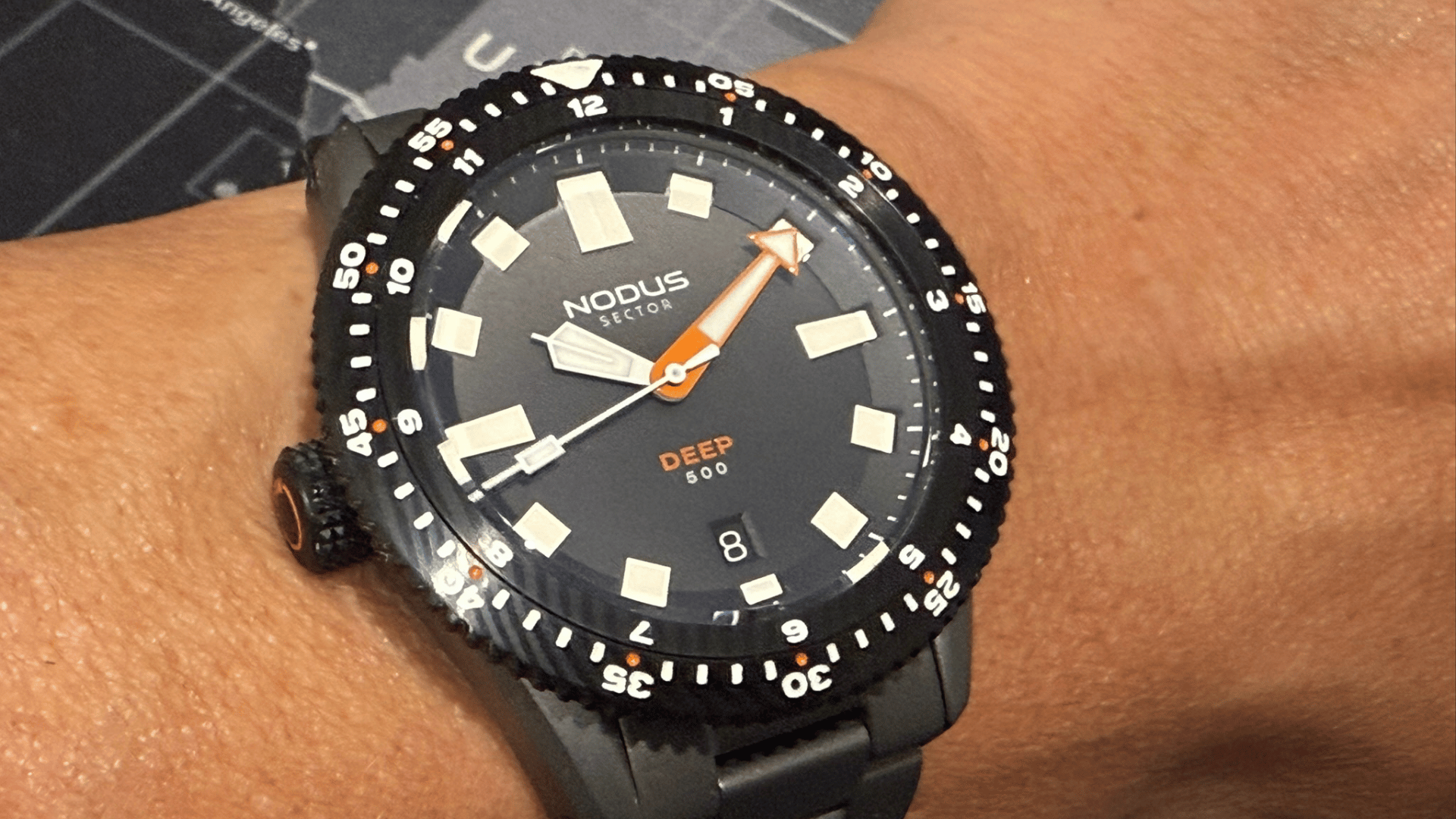
It’s hard to believe some of the Sector Deep Damascus’s details for the price of $800. The case is 316L surgical-grade stainless steel measuring 38mm across with a 42mm bezel overhang, 13.6mm thickness, and a 47mm lug-to-lug, finished with a gray DLC coating and sandblasted texture for a stealthy near-black-ops look. It hovers beautifully between silver and jet black. More watches should be done up this way. It’s not just attractive. It’s also highly resistant to scratches. The gradient gray dial nicely departs from flat black or sunburst patterns, giving the watch even more personality in a subdued manner.
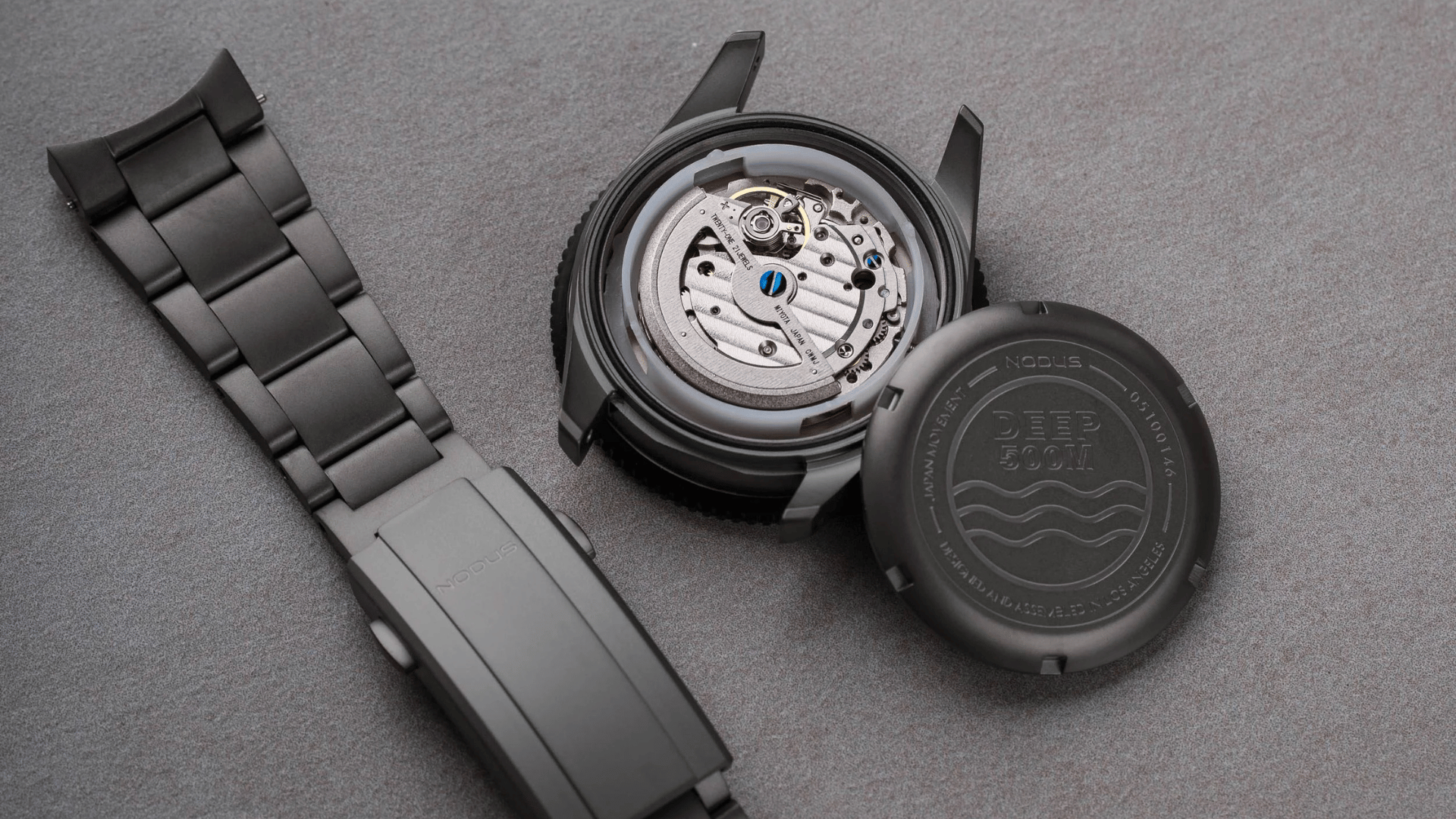
It’s fitted with a flat sapphire crystal carrying a blue anti-reflective coating, a screw-down crown, and a screw-on caseback that helps the watch achieve an impressive 500 meters of water resistance. Power comes from the Miyota 8315 automatic movement, a Japanese workhorse caliber with 21 jewels, a 60-hour power reserve, and antimagnetic resistance greater than 4800 A/m, regulated in-house by Nodus to an accuracy of plus or minus 10 seconds per day. The movement might not impress some at this price, but the in-house regulation should.
The 20mm bracelet tapers to 16mm at the clasp and uses Nodus’s proprietary NEM (Nodus Extension Module) folding clasp with quick-release spring bars and a tool-free sliding extension, great for wrist swelling in the afternoon summer sun.
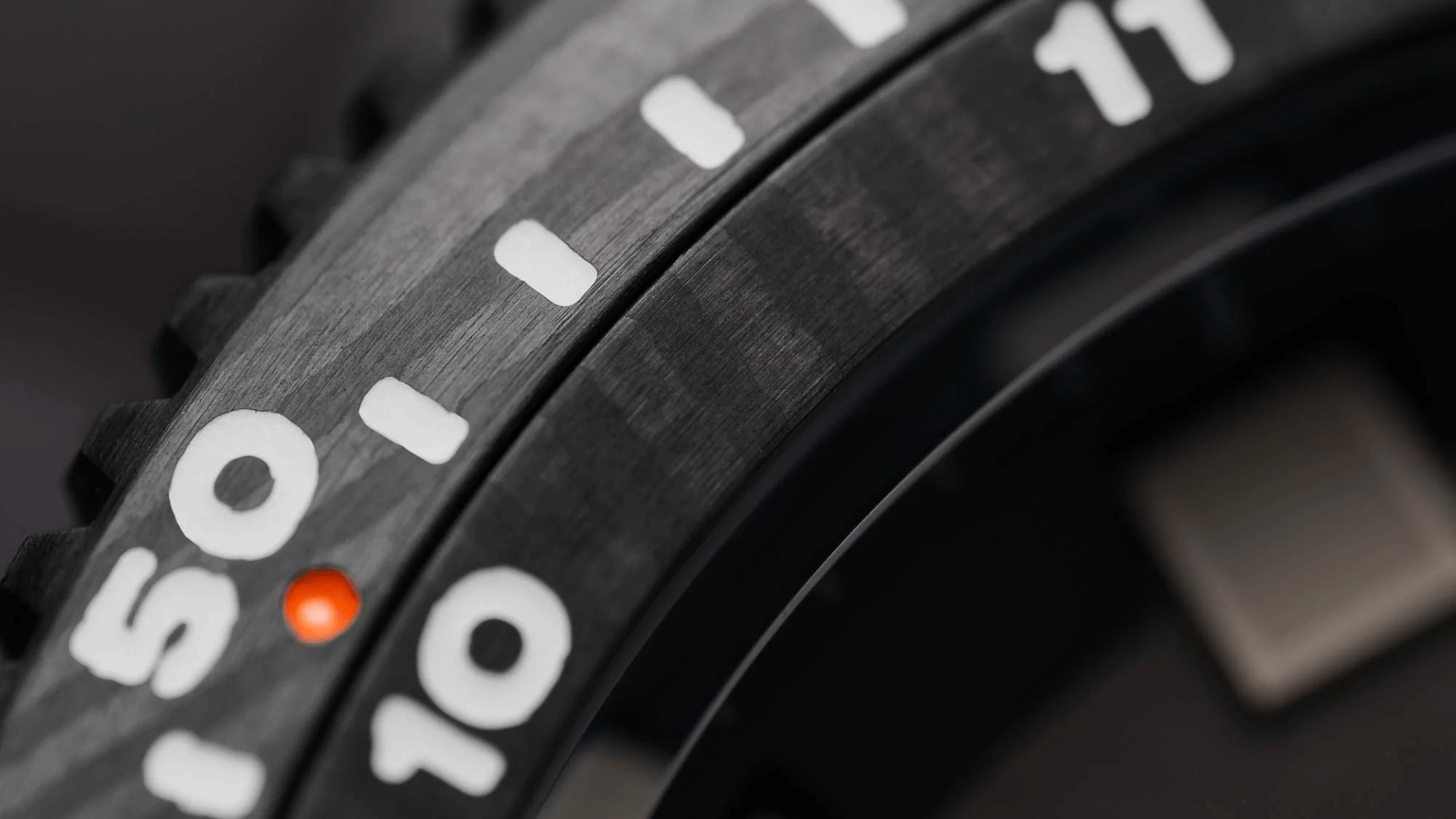
Then, there’s the bezel. One of the most unique executions I’ve ever experienced on a watch.
Nodus Sector Deep Damascus | Photo via Nodus
The Unique Use of Damascus Steel
What separates this Sector Deep from prior versions is its 120-click unidirectional bezel, made from Damascus steel and finished in black DLC. Damascus steel is produced by folding, compressing, and heat-treating multiple steel alloys together, creating an etched, wavy grain pattern that is inherent to the metal itself rather than printed or applied afterward, meaning every bezel is genuinely one-of-a-kind. The level of craftsmanship is astounding for the $800 price.
This construction technique is more commonly seen in high-end EDC pocket knives, where the pattern is typically exaggerated through aggressive heat treatment, but Nodus took the opposite approach, muting the wavy texture beneath a light black DLC coating for a subtler, more integrated look. I haven’t come across a watch that looks or feels like this, regardless of price.
The bezel still carries full 60-minute dive markings and a 12-hour second time zone scale, engraved and filled with Swiss Super-LumiNova BGW9 lume that glows blue in the dark, so the Damascus treatment adds visual intrigue without sacrificing real-world function. It’s not just an impressive look, though. The finishing is meticulous, and there’s no play in the bezel. Watches costing many times more don’t have these tight tolerances.
Nodus Sector Deep Damascus | Photo by Amos Kwon
How It Wears
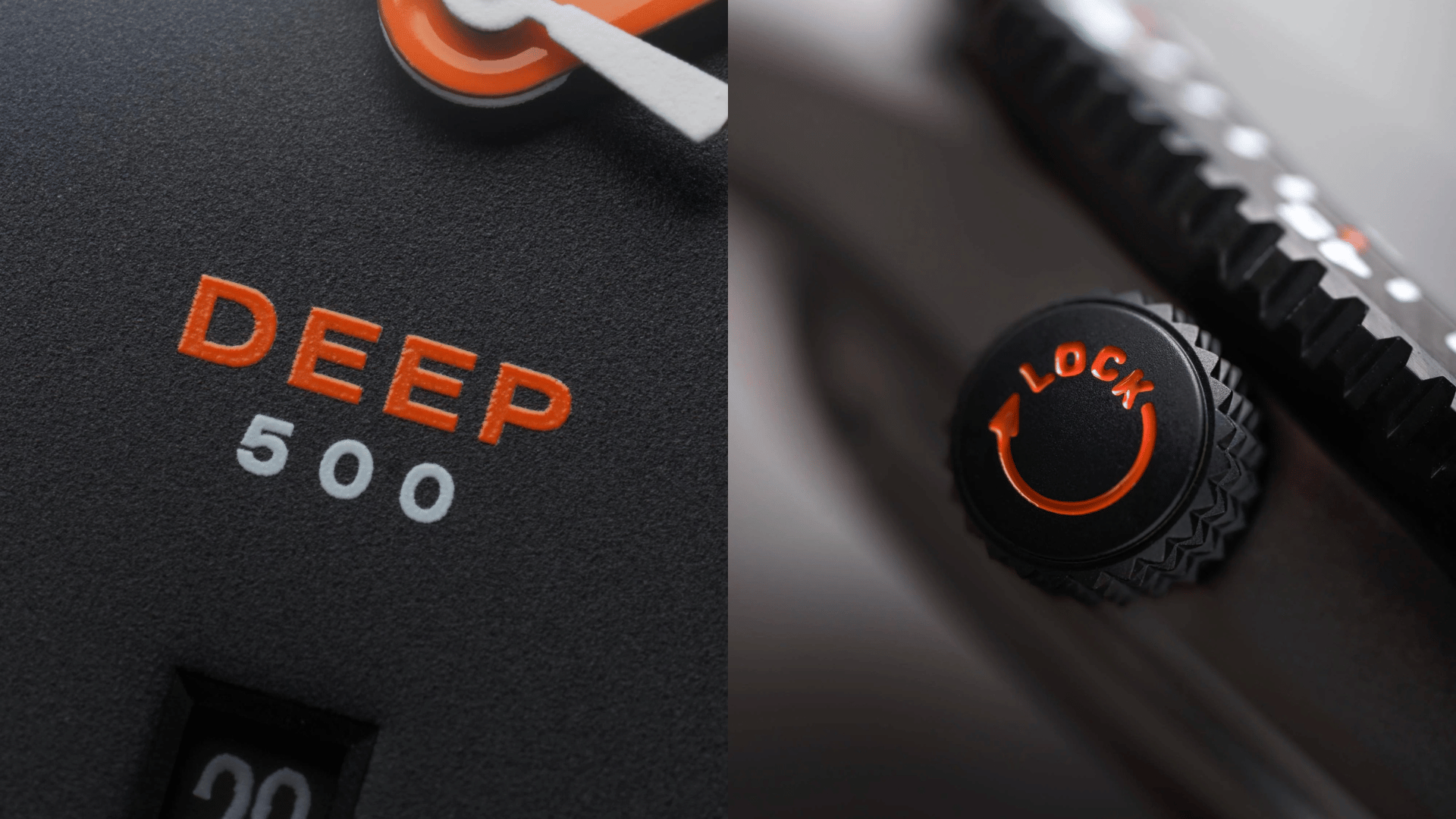
On the wrist, the Sector Deep Damascus wears very comfortably. It can be attributed to the manageable case size, as well as to the short lugs and rounded caseback. In terms of looks, it’s not quite tactical in appearance, and that means it’s more versatile. The understated aesthetic is mildly stealthy: a black dial, bezel, case, and bracelet paired with bold white hour markers plus orange and white hands for legibility. The peppering of orange on the bezel pips, the wonderfully knurled crown, and the D-E-E-P dial lettering complete the stealth/sporty aesthetic.
The 42mm bezel overhangs the 38mm case, which both reinforces the grip of the bezel’s gear-teeth edge and doubles as a crown guard, a practical touch for a tool watch meant to take some abuse. At 13.6mm thick and 79 grams, it wears comfortably for a 500-meter diver, and the destro-style crown placement plus the fully lumed hands, markers, bezel keep it functional in low light. The overall effect is a watch that looks deceptively simple at a glance but rewards closer inspection with layered texture and detail once the Damascus grain and lume-filled engravings catch the light.
Nodus Sector Deep Damascus | Photos via Nodus
The Value Proposition
Priced at $800, the Sector Deep Damascus sits near the upper end of Nodus’s lineup but remains well under the $1,000 mark. For that price, buyers get a 500-meter water-resistant case, sapphire crystal with AR coating, a tried and tested Miyota 8315 automatic movement regulated in-house to +/- 10 seconds per day, a quick-release bracelet with a proprietary tool-free clasp, and a bezel made from a labor-intensive material typically reserved for boutique knives or watches costing several times as much.
Nodus backs the watch with a 24-month international warranty and a 14-day return or exchange window, reinforcing the brand’s consumer-friendly, direct-to-customer business model. Given that genuinely serialized, unique Damascus steel components are almost non-existent below the $1,000 mark, this release reinforces Nodus’s reputation for packing real value and original design into each successive generation of the Sector Deep.
I have a handful of premium watches in my collection, and the Nodus Sector Deep Damascus could easily earn a rightful place among Sinns, Omegas, Certinas, and Marathons. The aesthetics and construction are spot-on, and the approachable price is almost hard to fathom for what the Sector Deep Damascus offers.
It’s a tool watch extraordinaire, the best one I’ve encountered in recent memory.
More Watches

The Cool Material 2026 Fall Style Guide
Our favorites for fall. Your shortcut to style.

Black Book: 12 Products Our Editors Loved in September 2026
The products our editors have been obsessed with in September 2026.
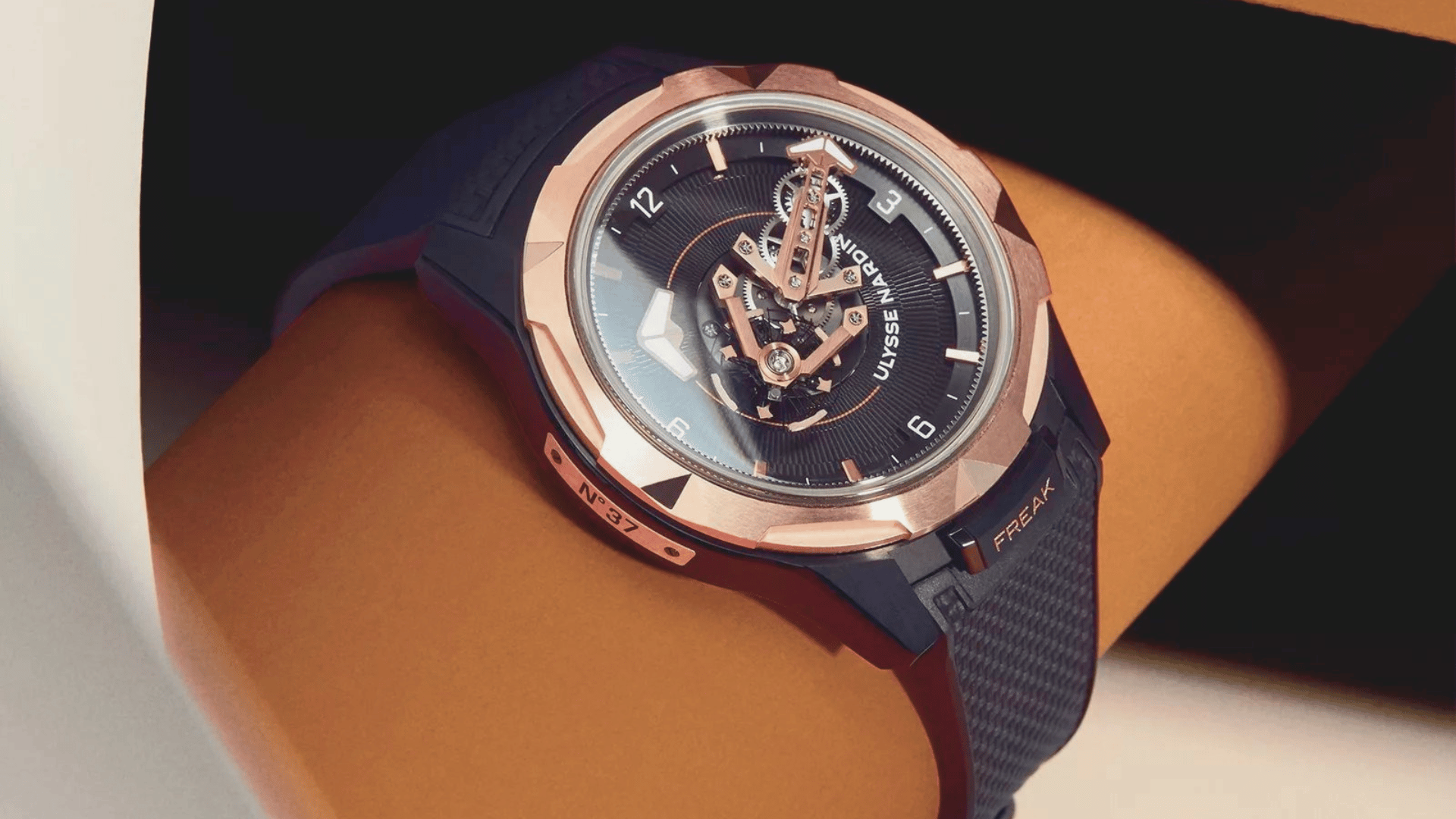
What It’s Like to Wear an $85,000 Watch
I spent some wrist time with the Ulysse Nardin Freak ONE Gold, a wonderfully strange feat of watchmaking with no dial, hands or crown.
-
Watches
The Cool Material 2026 Fall Style Guide
Our favorites for fall. Your shortcut to style.
-
Watches
Black Book: 12 Products Our Editors Loved in September 2026
The products our editors have been obsessed with in September 2026.
-
Watches
What It’s Like to Wear an $85,000 Watch
I spent some wrist time with the Ulysse Nardin Freak ONE Gold, a wonderfully strange feat of watchmaking with no dial, hands or crown.