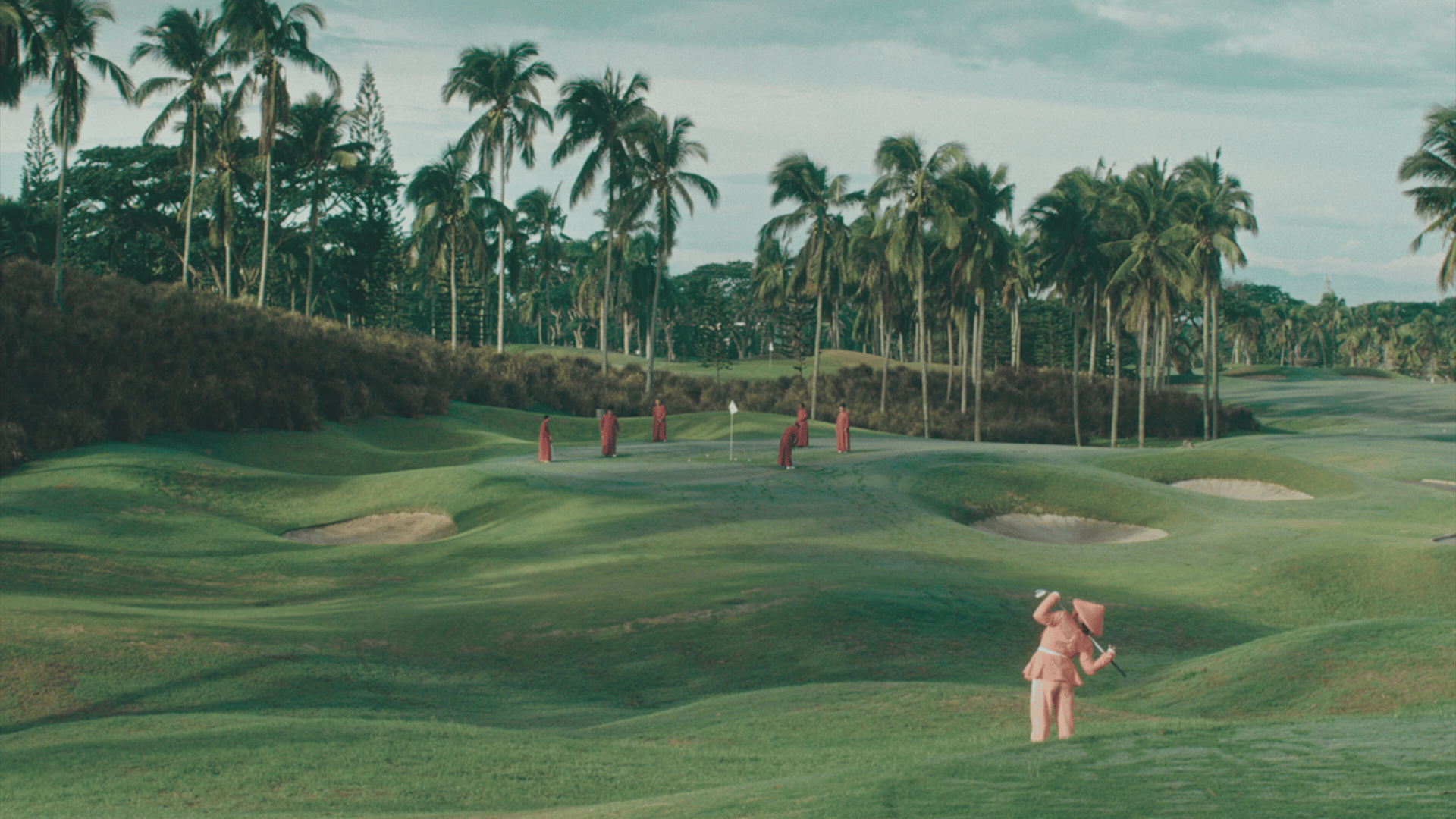
Shooting a film that’s set on a golf resort in a 4:3 aspect ratio only works if the point is to communicate gaps in stature between haves and have nots. A boxy presentation like 4:3 winnows down where the viewer’s eyes wander and forces them to engage with the world through a limited scope; it’s restrictive and cramped, an unorthodox choice for a story shot against rolling hills and manicured putting greens. But no other format would work as well in Filipiñana, the terse and tightly shot feature debut of Filipino filmmaker Rafael Manuel, where a day on a golf course becomes a lesson in power dynamics and contemporary Philippine history.
In fact, structured by 4:3’s confines, the film thrives. Manuel’s style is cool and breezy, a welcome complement to his sober subject matter; his filmmaking knits casual ease with rigorous composition, capturing the relaxed atmosphere of Filipiñana’s location while at the same time establishing its stakes. This is not a movie about golf. Instead, it’s a movie about what is sacrificed by the wealthy for their self-indulgence, and the people they rob of their heritage, culture, and land to satisfy these pursuits. The trope here is well-worn: the rich take and the poor suffer. But Manuel’s contextualization of that trope within the Philippines’ contemporary history and colonial influence feels new, and his approach to directing conveys a sense of placid unrest.

Filipiñana manifests its social layers in a handful of ways, starting with perspective. Manuel cuts back and forth between his two protagonists: Isabel (Jorrybell Agoto), a tee girl working at a prestigious golf club situated around Manila’s city limits; and Clara (Carmen Castellanos), a Filipina expat on a visit with her uncle, Renato (Carlitos Siguion-Reyna), who spends most of the movie attempting to cajole her into taking over his golf equipment company once he retires. Clara comes from money. Clara has money. At the same time, she hangs on a lower social rung than Renato as an outsider, similar to Isabel, but with admittedly more privilege. Filipiñana paints a robust portrait of the club’s operation through their joint perspectives, and indeed, what ground the club is even operating on.
Manuel gives heavy consideration to class division. Boundaries that separate the “haves” from the “have nots” are expressed through his framing; when Isabel and her fellow tee girls go to work on the driving range, Manuel puts them at the camera’s center while the golfers (who are all men) stand between them, forming a series of khaki towers over the young women’s heads. (The blocking’s sexual undertones probably aren’t coincidental, either.) It’s tiered imagery: the men stand above women, the rich above the poor, the customer above the staff. The implications aren’t subtle, and gain volume through Manuel’s muted, naturalist filmmaking. Literally, we’re on Isabel’s level while she makes small talk with Dr. Palanca (Teroy Guzman), the club’s president. If the phallic symbolism invoked by the golf clubs isn’t enough of a hint, Isabel’s position relative to Palanca acts like a blinking neon scene that we’re in Freudian territory here.
We’re in hazy thriller territory, too. Palanca is from the same region in the Philippines as Isabel, Ilocos, the rural home she left in search of opportunity; that and his performative altruism stirs an innocent crush in her. But Filipiñana, like Brazilian filmmaker Kleber Mendonça Filho’s Academy Award nominated gem The Secret Agent, is centrally about a failure of collective memory. Decades pass, and people forget who is responsible for, in this case, uprooting them from their land. None of the characters representing the upper class in Filipiñana are who they seem. Kindness and good manners are a front masking guilt. Maybe that’s why Manuel chose to shoot the movie with a laidback frame of mind: as a smokescreen to obscure what’s really going on at the club.
It’s an obvious sleight of hand in retrospect, but it’s a good sleight of hand, because it works. How else do a nation’s wealthiest people not only preserve their wealth but gain more of it? The everyday folks in Filipiñana dare not ask that question because nobody’s going to show them where the bodies are buried; making an omelette means breaking a few eggs, and reaching billionaire status means shattering thousands of lives. Filipiñana isn’t interested in the gory details or exposing the unsavory deeds of the club’s clientele, but the message is received anyways. Through Isabel and Clara, as well as Manuel’s lens, we understand that this place of pristine, impeccably maintained artificial beauty is the product of the worst inhumanity: the kind that wears a smile and pretends to see lower classes as human, when in fact they see them as potential obstacles to their enrichment. It’s a chilling thought. At least Manila’s heat can keep us warm.