
One thing you forget in the long stretches between the last time you watched Jaws: it absolutely rips. Pop culture has so thoroughly broken the film down into its component parts over the decades that one might recollect it via the lagoon attack, the shark’s dramatic reveal from the stern of the Orca, the underwater cage sequence, or Martin Brody’s climactic sendoff to his nemesis, at the business end of a scuba tank. It’s for good reason that our brains tend to dredge up these moments first when the subject of shark cinema surfaces; they’re the stuff of superb, thrilling drama.
But sitting down with Jaws in the year of its 50th anniversary, it’s remarkable to see just how fast a clip Steven Spielberg maintains from the opening scene, where Chrissie Watkins (Susan Blacklinie) takes her fateful final dip in the Atlantic Ocean, to its last, where Brody (Roy Scheider) and Matt Hooper (Richard Dreyfuss) swim to shore without a care in the world as the shark’s exploded carcass sinks to the depths. This isn’t a slow burn style of movie; it’s a vigorous sprint, whose finish line glimmers on the horizon. Yet neither we nor Spielberg are in any hurry to get there. Jaws simply moves, and we along with it, determined, constant, but totally unrushed at the same time. There’s an inevitability baked into the film’s structure and pacing, necessary for keeping our dread circulating.
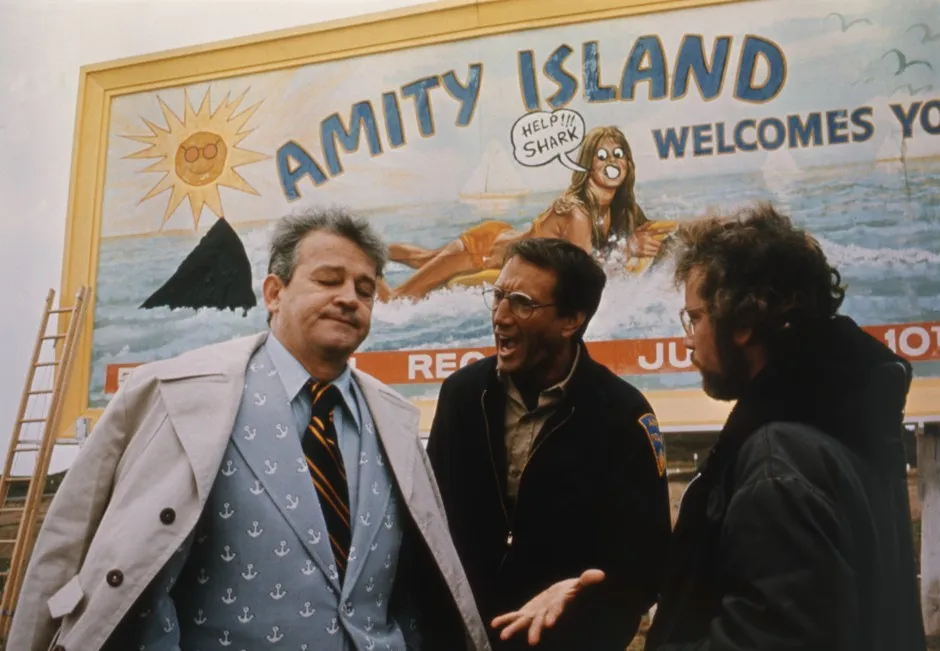
Brody and Hooper attempt to talk some sense into Mayor Vaughn.
Universal Pictures
A Timeless Message
In post-COVID times, a clear entry-point to the film is bureaucratic negligence. Amity’s nattily dressed mayor, Larry Vaughn (Murray Hamilton), transcended into our lexicon of memes during the pandemic; his phony-baloney reassurance to reporters seemed to perfectly encapsulate American politicians’ disregard for stemming the disease’s tide. Fair is fair: those elected officials got the mockery they deserved, though Vaughn eventually turns sympathetic, driven by guilt to empower Brody’s efforts at killing the shark. Better late than never.
More striking than Spielberg’s prescience, though, which frankly feels more akin to common-sense acceptance that politicians will put dollars before people, is his elegantly simple approach to the then-nascent blockbuster form. It’s a common lament today that modern studio spectacle lacks character, originality, execution, and innovation. All of that is true, to the extent that the complaint itself is by now shopworn and musty. More isn’t always more. Jaws made do with “less” out of necessity, because the damn mechanical shark just couldn’t get its act together, and no multi-million dollar funded studio project in the 2020s would put up with malfunctioning FX. (They are, however, totally fine with shoddy FX.) But there is something to be said for Spielberg’s emphasis on character and dialogue, no matter the larger contextual reason.
It is meaningful that today’s better received tentpole movies are often those with good interplay between the cast, a’la Marvel’s Thunderbolts: people like watching talented, cool actors chop it up with one another. Whenever Jaws centers on exchanges between any combination of Scheider, Dreyfuss, Hamilton, and Robert Shaw—the crusty and coarse shark hunter Quint—is a joy, and since most of the plot hinges on their dialogue, that joy becomes its fuel. Brody is driven to do what’s right for his constituents; Hooper lets his awe of carcharodons guide him; Quint simply wants a fat payday for doing what he’s best at. Vaughn probably thinks he’s doing what’s right for Amity when hamstringing Brody, too, but his calculus is so patently wrong that connecting with him on an emotional level is nearly impossible, until the resolution of Michael’s (Chris Rebello) terrifying encounter with the shark.
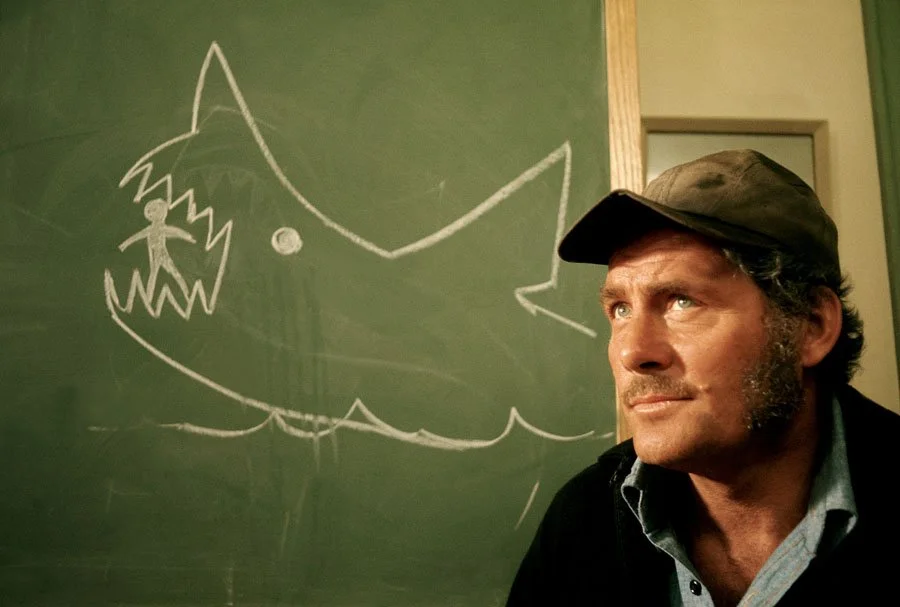
Robert Shaw as Quint.
Universal Pictures
A Rare Breed
If it’s unusual for 2020s-era blockbusters to find their footing in character politics, it’s even more uncommon that post-Jaws shark movies take themselves seriously. Syfy’s Sharknado franchise eclipsed Jaws with Sharknado 5: Global Swarming in 2017 (or 2016, if you go by the series’ Lavalantula spin-offs). That brand’s “so bad it’s good” style makes up the bulk of the modern shark genre, where viewers are nudged in the ribs by self-aware meta “humor” hard enough to cause fractures. Sometimes, such giddily silly aesthetics pay off. (See: Morihito Inoue’s Hot Spring Shark Attack.) Mostly they’re ugly, and practically contemptuous of the niche’s basic conceit. (See: Sharktopus, Ghost Shark, Sand Sharks, 2-Headed Shark Attack, Toxic Shark, The Meg 2, Under Paris, and beyond that, take your pick of the trash.)
Peppered among these are “grounded” shark movies, where everyday folks have lethal brushes with sharks while doing everyday things. The Shallows, 2016’s unexpected solid Blake Lively vehicle, and Dangerous Animals, Sean Byrne’s expectedly solid Jai Courtney vehicle, come immediately to mind. Movies like these read as truer products of Jaws’ legacy, fixated foremost as they are on people instead of absurdist premises. (Dangerous Animals, admittedly, is about a serial killer who dunks his victims into shark-infested waters, which is just a little bit absurd, but the execution pays off the foolishness.)
Still, good as they are, imagining these movies enduring five decades from now is difficult. Not every film can be a monumental classic like Jaws; otherwise, the distinction would have no meaning. But Jaws sets such a powerful example of its form that no shark movie made since can compare to it. We aren’t afraid of going in the water to this day because of tackily rendered CGI sharks. We’re afraid because Spielberg burned the image of Bruce breaching the Orca’s wake into cultural consciousness half a century ago.