

Bob Gale needed a joke. The writer and producer of Back to the Future was already in the throes of production, but there was a big hole in his script. Soon after driving a time-traveling DeLorean 30 years into the past and crash-landing in 1955, Marty McFly (Michael J. Fox) runs into a local diner, and the owner says… something funny?
That was the problem facing Gale and director Robert Zemeckis. To solve it, they turned to costume designer Deborah Lynn Scott.
“The joke wasn’t in the original script,” Scott tells Cool Material. “They came to me saying, ‘We need something here.’”
Scott, whose credits also include E.T., Titanic, and the Avatar movies, quickly got to work coming up with a piece of Marty’s outfit that could set up a quick punchline. It had to be something a normal teenager would wear in the ‘80s that would confuse someone from the 1950s.
Then, inspiration hit.
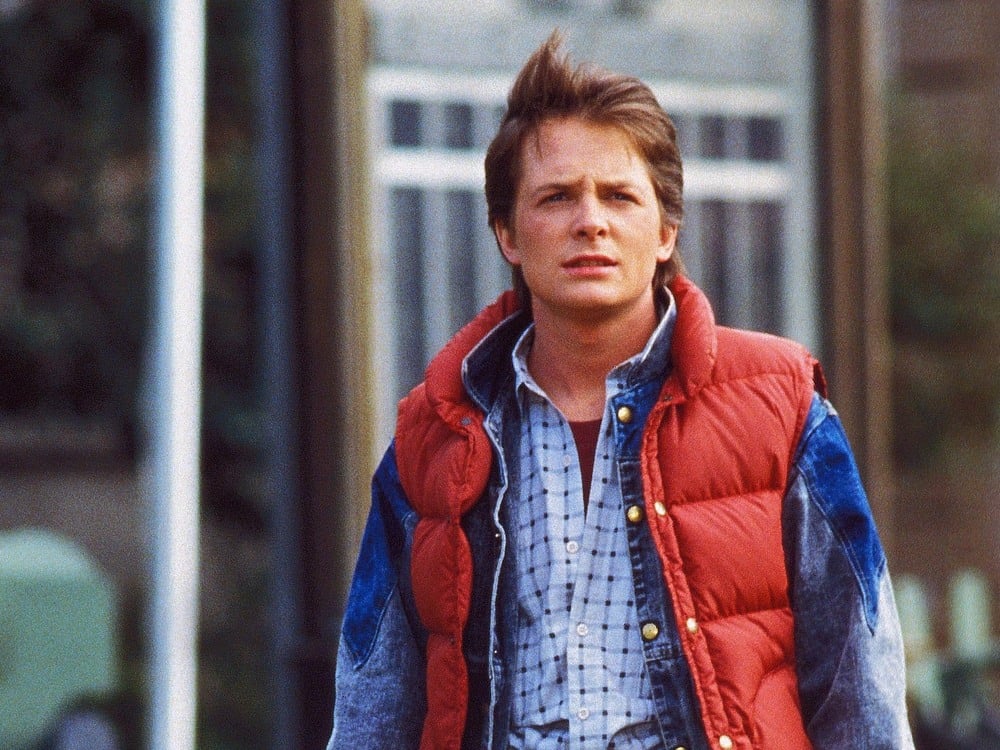
“We had some cold weather on set, and I thought, What about a down vest? That wasn’t around in the ’50s,” Scott says, noting that North Face apparel had become very popular at the time the movie was made.
She brought the idea to Gale and Zemeckis, and they liked it, although Scott recalls that her original color choice “stood out too much” and they ultimately landed on a rusty orange hue. That puffy accessory sparked an idea for a joke in which the diner owner, Lou, assumes Marty’s vest is actually a life jacket. The scene plays out like this…
Lou: Hey kid, what’d you do, jump ship?
Marty: What?
Lou: Well, what’s with the life preserver?
It’s a quick, almost disposable joke in a movie packed full of them, but even 40 years after Back to the Future first premiered in July 1985, it still holds up.
“It’s a great example of how costume can help drive the narrative,” Scott says. “That’s the beauty of design: We can find characters, but we can also help the narrative in very specific ways.”
Universal Pictures
How to Dress Like Marty McFly
Everything Fox wears in Back to the Future was carefully selected with one clear goal in mind: to stand out from the world of the 1950s, without arousing too much suspicion.
“If he walked down the street, you might have to look twice,” Scott says, “but you don’t want him to jolt the audience out of their suspension of disbelief.”
Marty wore Guess jeans and Nike sneakers, popular brands in the ‘80s that also didn’t look too out of place three decades earlier. (Sneakers first became mainstream in the 1950s.) Even his underwear had to fit the pattern. In that case, however, it also served a dual purpose as the inspiration for another classic Back to the Future joke in which one character mistakenly assumes Marty’s name is Calvin, because “it’s written all over your underwear.”
“Calvin Klein was hugely popular in the ’80s,” Scott says, “so it worked as a great gag.”

Universal Pictures
Doc Brown, Style Icon
Doc Brown (Christopher Lloyd) might be best known for his unkempt bone-white hair and his matching lab coat. But for Scott, it’s the clothes beneath his iconic overcoat that define him. Most of Doc Brown’s getup was either vintage or new clothes made from vintage fabrics.
“As we developed the character, we established that he had money—family money or maybe from inventions,” she says. “He wasn’t a starving artist. That led me to think he might be a bit of a fashionista. His underlayers were fitted and stylish. He had slacks, cool shoes, and an eclectic way of dressing.”
As for that lab coat, that costume choice was once again born out of necessity. This time, it needed to match the tone of the movie’s most dramatic scenes, which revolve around Doc Brown’s retrofitted DeLorean and his attempts to break the laws of space and time.
“We needed the overcoat to have motion in certain outdoor scenes, especially with the weather,” Scott says. “So we thought: What could he wear from the ’50s that also gives him something to work with as a character?”
The answer invented a new cinematic archetype.
Universal Pictures
Future Imperfect
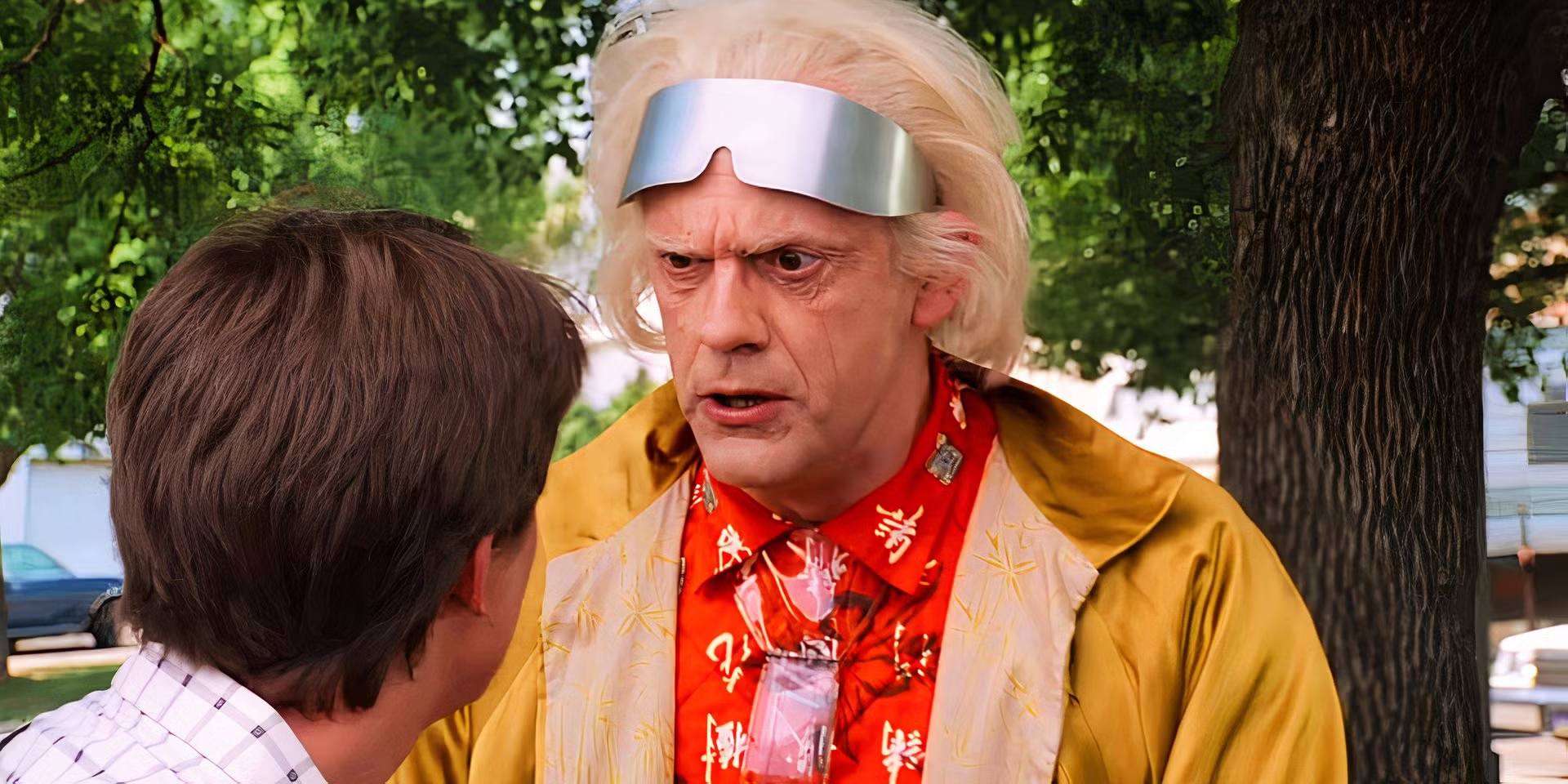
The most difficult problem Scott faced comes at the end of the movie. Marty returns home to a dramatically better version of his life in 1985 (thanks to some tampering in 1955), only for Doc Brown to come racing out of the future with a warning about Marty’s kids — and a setup for the sequel.
In that moment, Scott had to figure out a way to subtly indicate that Doc was traveling back in time from the future without making any bold predictions about what that future might look like.
“That was tricky,” she says, “What does it mean to be dressed from the future? We had endless discussions. We didn’t want it to feel like Star Trek. It had to stay character-driven. So we made his tie out of clear plastic—men have worn ties for centuries, but this one is odd. It made you curious without anchoring it to a specific idea of the future.”
Back to the Future 2 brings Marty and Doc to the far-flung year of… 2015. A decade later, in 2025, we can confirm that transparent plastic ties sadly never caught on with the general public (then again, Doc Brown has always been a fashionista). But for Scott, who didn’t work on the sequel but sees her influence on its vision of the future, actually getting those predictions right was besides the point.
“There were times when we looked at each other and went, Oh my god, does anyone know what people are going to wear in the future? I remember thinking, If I did, I’d be a billionaire!”