
Actor, comic, and current SNL cast member Bowen Yang recently visited the hallowed Criterion Closet for a customary grab-bag spree. Perhaps against expectation, his first pick was the Collection’s Police Story/Police Story 2 release, early masterworks in the career of living legend Jackie Chan.
“Kind of the first movie star in our household,” Yang says of Chan, before rightly lamenting our current state of multiplex affairs: “I think superhero movies have unseated these amazing martial arts movies.”
The contrast of “movie star” with “superhero” here applies to Chan as well as the generation of young actors whose careers he inspired, like Hong Kong’s Stephen Chow, a master of mo lei tau filmmaking and diligent student of martial arts cinema. If you’ve never had the pleasure of sitting with his movies, imagine Victor Frankenstein stitching parts of Chan to parts of Mel Brooks, with Chow emerging as the fruit of the mad scientist’s labor; now you have a solid starting impression of his work.
In 2004, Chow produced Kung Fu Hustle, his umpteenth film role, sixth go-round as director, and an enduring embodiment of what his style encompasses. Contemporarily, there may not be a better escalation of Chan’s influence on martial arts filmmaking and Hong Kong’s broader movie industry. Popularly, Kung Fu Hustle is given context as a live-action Looney Tunes skit, which is a totally fair comparison. At the same time, the dots Yang connects between the martial arts movies of Chan, and implicitly his peers, and the superhero movies that mostly dominate theater chains today, cast Kung Fu Hustle in similar light. Yes, Chow flees a rampaging landlady in a sequence inspired by the neverending chase between the Road Runner and Wile E. Coyote, and it’s hilarious. Now, more than two decades after its initial release, the film’s final set piece remains a boisterous reminder that martial arts cinema’s protagonists frequently behaved as superheroes in their own right.
Sony Pictures Classics
Appearances Can Be Deceiving
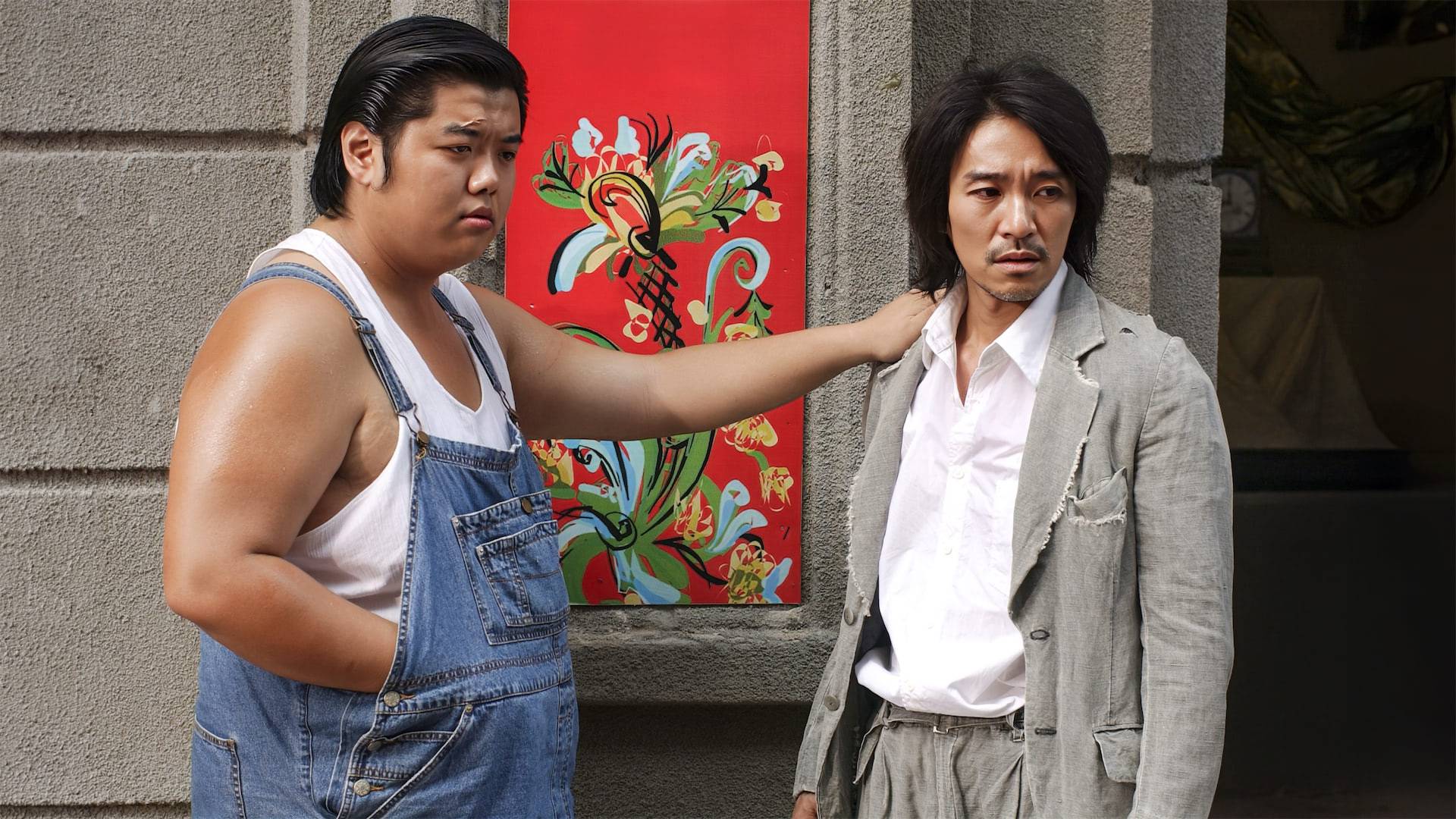
Kung Fu Hustle is set in 1940s Shanghai, where Brother Sum (Danny Chan Kwok-kwan) reigns supreme over China’s criminal element. By the time the movie opens, he and his Axe Gang have finished scouring the country of every single rival outfit, an achievement celebrated with a dance number. Sing (Chow) and his buddy Bone (Lam Chi-chung), who secondarily serves as Sing’s punching bag, desperately seek entry into the gang, in part because that’s all that’s left, and in part because Sing has unresolved childhood trauma he deflects by choosing a life of crime. No matter.
The duo fake it to make it and attempt to hustle the residents of a slum, Pigsty Alley, whose residents give them more resistance and trouble than expected, which draws the the attention of the actual Axe Gang and leads to a shocking revelation: three Pigsty folks happen to be kung fu masters in hiding.
Visual gags and punchlines abound, some of which admittedly don’t translate seamlessly from Cantonese to English. Kung Fu Hustle is a deeply silly film. The aforementioned landlady (Yuen Qiu), is a chain smoking battleax who regularly picks on Pigsty’s renters and her horndog husband (Yuen Wah). When Sing and Bone try to shake down the locals, a procession of would-be challengers to his threats walk forward from the crowd, each of them unreasonably jacked, from an octogenarian man to a little kid. The incognito masters, Coolie (Xing Yu), Tailor (Chiu Chi-ling), and Donut (Dong Zhihua) have a friendly sparring match that ends with each respectfully bowing to the others from a balcony’s balustrades, and Tailor slipping and falling backwards. But Chow uses dynamic, inventive, and joyfully choreographed fight scenes as connective material tying together his relentless madcap humor like a living room rug.

Sony Pictures Classics
A Lasting Legacy
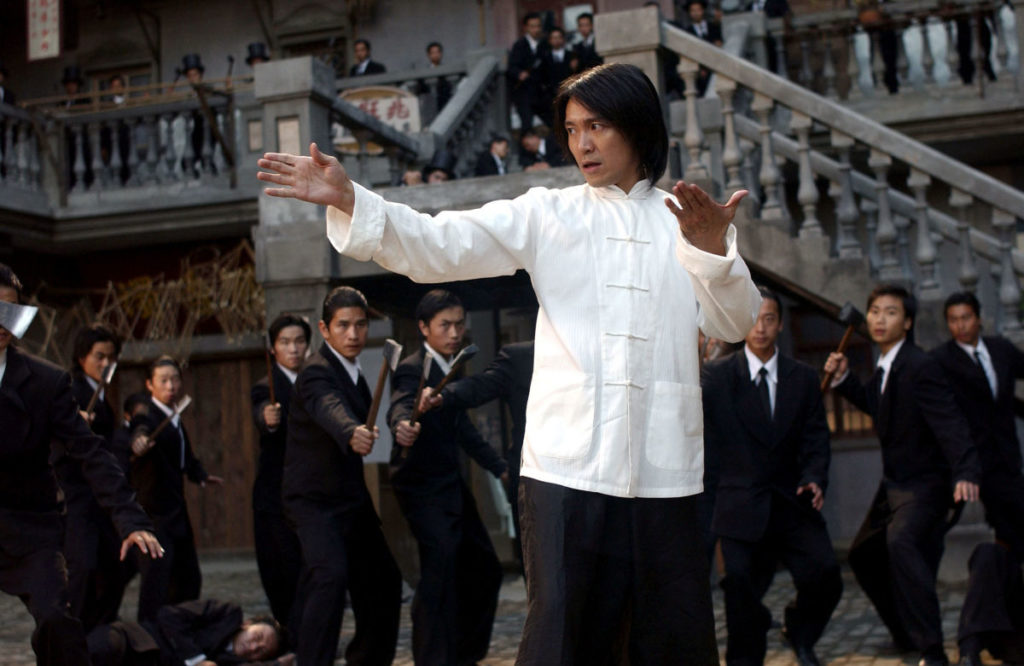
Visually, Kung Fu Hustle is a tribute to Bruce Lee, who Chow wanted to be when he grew up, like pretty much every other kid born in 1960s Hong Kong. By the time Sing’s character arc completes, emerging from a literal cocoon in Lee’s outfit from Enter the Dragon–white shirt, black pants–the metaphor drives home. The references made to Lee elsewhere in the movie, including Landlady mimicking his iconic nose flick, finally come together. Chow compliments the imagery with a dash of Lee’s own sense of humor, too.
The bulk of the film’s comic sensibilities come from Chan, who remains a flesh and blood cartoon character even in his old age: the pratfalls and goofs, the willingness to play the fool for a laugh regardless of his responsibilities as the hero, and the sheer love of that intersection between a good joke and a good fight.
Chan remains one of the movies’ greatest entertainers. Chow’s career has, of late, slowed down. But it deserves a fresh head of steam: he is, in the end, one of Chan’s greatest descendants. Kung Fu Hustle proves it.
Kung Fu Hustle is available to rent and buy on Amazon and Apple TV+.